
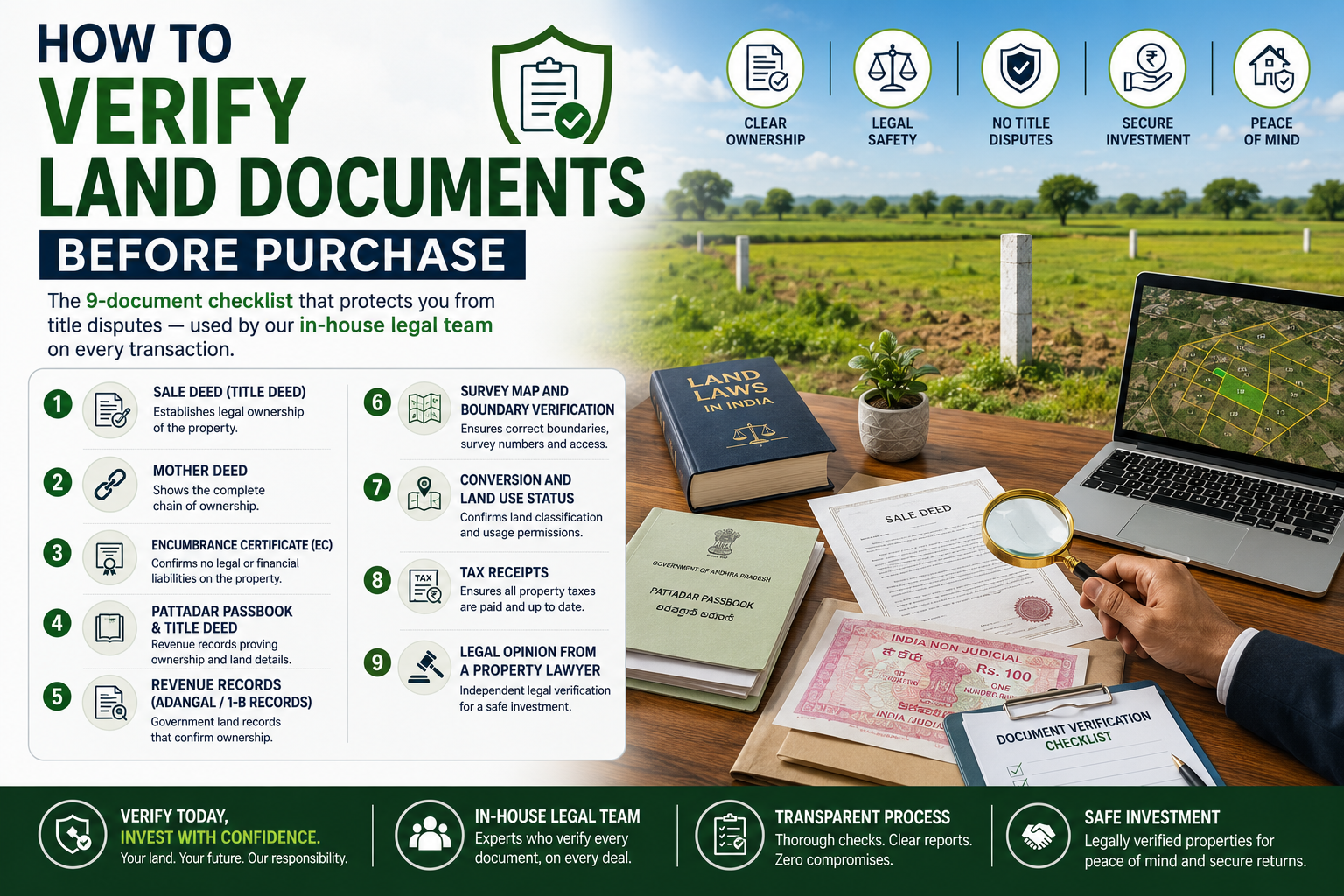
The 9-document checklist that protects you from title disputes used by our in-house legal team on every transaction.
Buying land is one of the most significant financial decisions you’ll ever make. Whether you’re investing in agricultural land, a managed mango farm, or purchasing property for future appreciation, verifying the legal documents before completing the transaction is essential.
Many land disputes arise because buyers rely solely on verbal assurances or incomplete paperwork. A proper legal verification can protect your investment and provide peace of mind.
At City Green Acres, every property undergoes a comprehensive legal due diligence process before being offered to buyers. Here is the same 9-document checklist our legal team follows.
1. Sale Deed (Title Deed)
The Sale Deed is the most important document because it establishes ownership.
Verify that:
- The seller’s name matches government records.
- The property description is accurate.
- Survey numbers and boundaries are clearly mentioned.
- The deed has been properly registered.
Never proceed if the seller cannot produce the original registered Sale Deed.
2. Mother Deed (Chain of Title)
The Mother Deed establishes how ownership has passed over the years.
Your legal expert should verify:
- Continuous ownership history.
- No breaks in title.
- No conflicting ownership claims.
- Proper transfer through sale, inheritance, or gift.
A clear chain of ownership significantly reduces legal risk.
3. Encumbrance Certificate (EC)
The Encumbrance Certificate confirms whether the property has any legal or financial liabilities.
Check for:
- Existing loans
- Mortgages
- Court attachments
- Previous transactions
- Pending claims
A clean Encumbrance Certificate indicates that the land is generally free from registered financial encumbrances.
4. Pattadar Passbook and Title Deed
For agricultural land in Andhra Pradesh, the Pattadar Passbook and digital Title Deed are essential ownership records.
Verify:
- Owner’s name
- Survey number
- Extent of land
- Classification
- Revenue records
Ensure these records are updated and match the registered documents.
5. Revenue Records (Adangal / 1-B Records)
Revenue records confirm the government’s land records.
These documents show:
- Current ownership
- Cultivation details
- Land classification
- Survey information
Any discrepancy between revenue records and registered documents should be investigated before purchase.
6. Survey Map and Boundary Verification
Always verify the physical land against official survey records.
Confirm:
- Boundary stones
- Survey numbers
- Access road
- Actual measurements
- Neighboring properties
A professional survey helps prevent future boundary disputes.
7. Conversion and Land Use Status
If you plan to develop the land in the future, confirm whether it is agricultural land or converted land.
Verify:
- Land classification
- Zoning regulations
- Government restrictions
- Development permissions
Understanding land-use regulations helps avoid future legal complications.
8. Tax Receipts
Ask for the latest land tax receipts.
Ensure:
- Property taxes are paid.
- There are no pending dues.
- Owner details match official records.
Unpaid taxes may create complications during ownership transfer.
9. Legal Opinion from a Property Lawyer
Even when all documents appear correct, a qualified property lawyer should conduct an independent legal verification.
A legal opinion typically includes:
- Title verification
- Ownership confirmation
- Encumbrance review
- Litigation search
- Registration compliance
- Investment risk assessment
Professional legal due diligence is a small investment that can prevent significant financial losses.
Additional Checks Before Buying Agricultural Land
Besides document verification, consider the following:
- Verify road access to the property.
- Confirm water availability.
- Check electricity connectivity.
- Ensure there are no ongoing local disputes.
- Visit the land personally before purchase.
- Verify government acquisition notifications.
- Speak with neighboring landowners if possible.
These practical checks complement legal verification and help you make an informed investment decision.
Why Legal Verification Matters
Skipping document verification can lead to:
- Ownership disputes
- Fraudulent transactions
- Encroachment issues
- Loan complications
- Delays in resale
- Financial loss
A legally verified property not only protects your investment but also makes future resale and financing much easier.
Why Choose City Green Acres?
At City Green Acres, transparency is at the heart of every transaction.
Before any property is offered for sale, our legal team conducts a thorough verification process that includes title verification, document scrutiny, boundary checks, and ownership validation. We believe that informed buyers make confident investors.

Leave a Reply